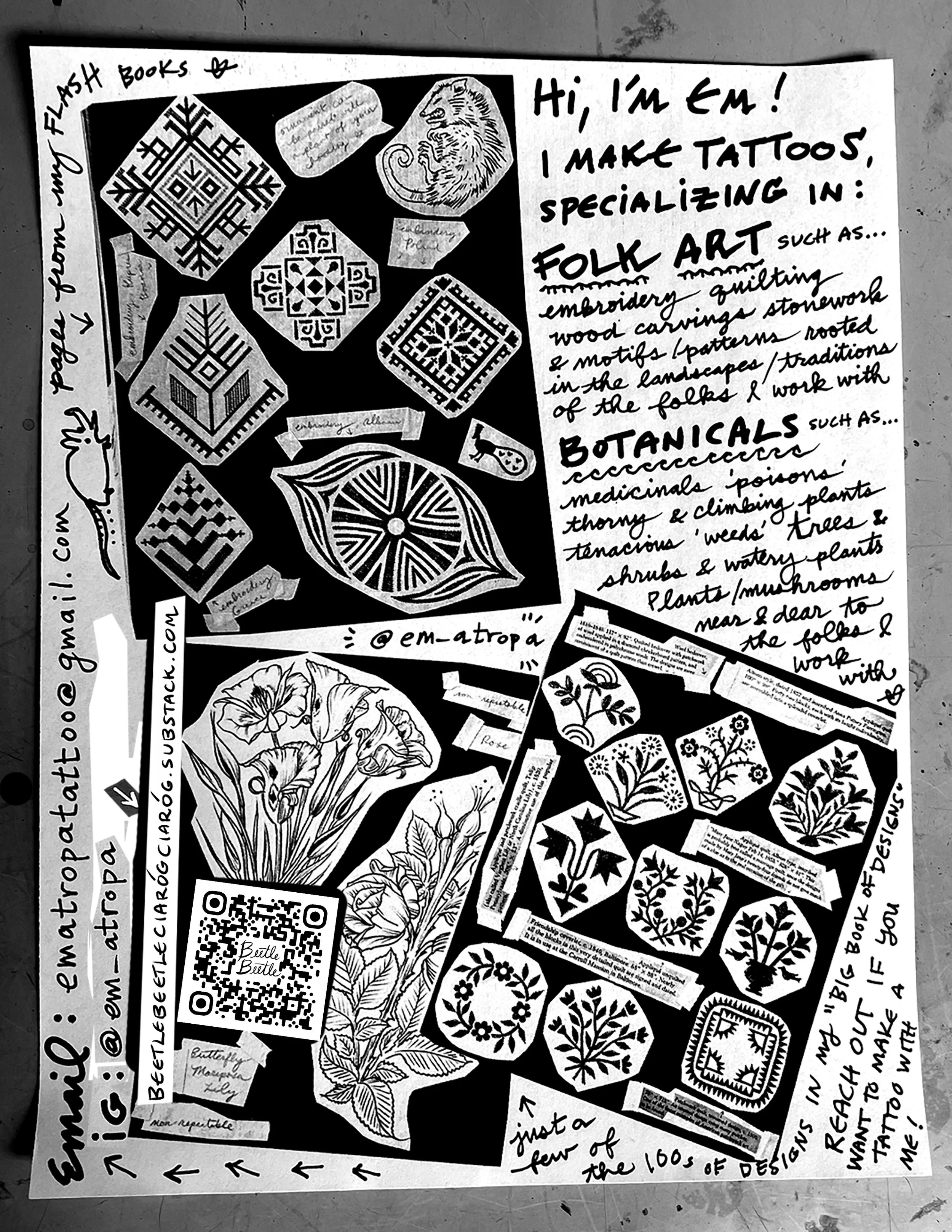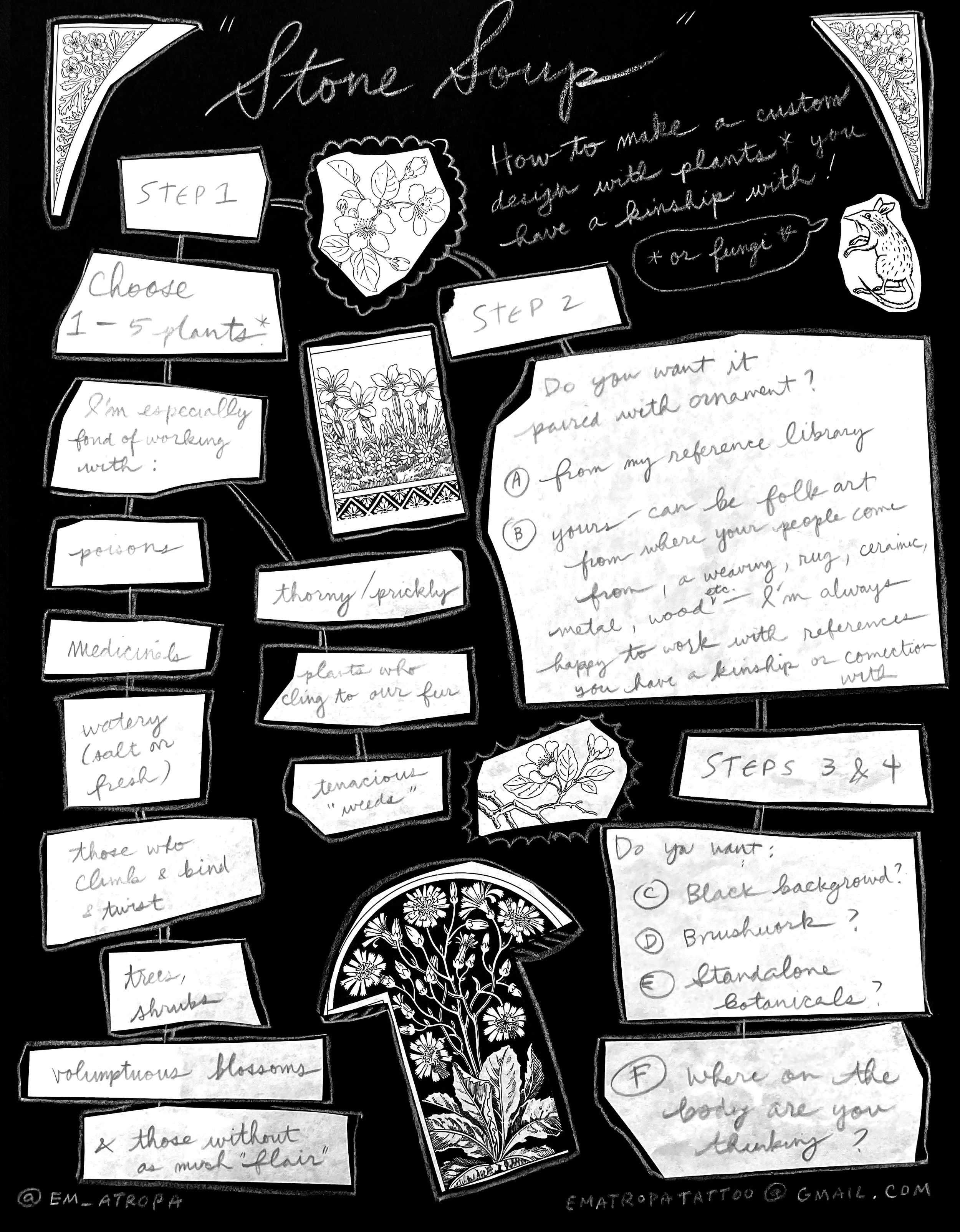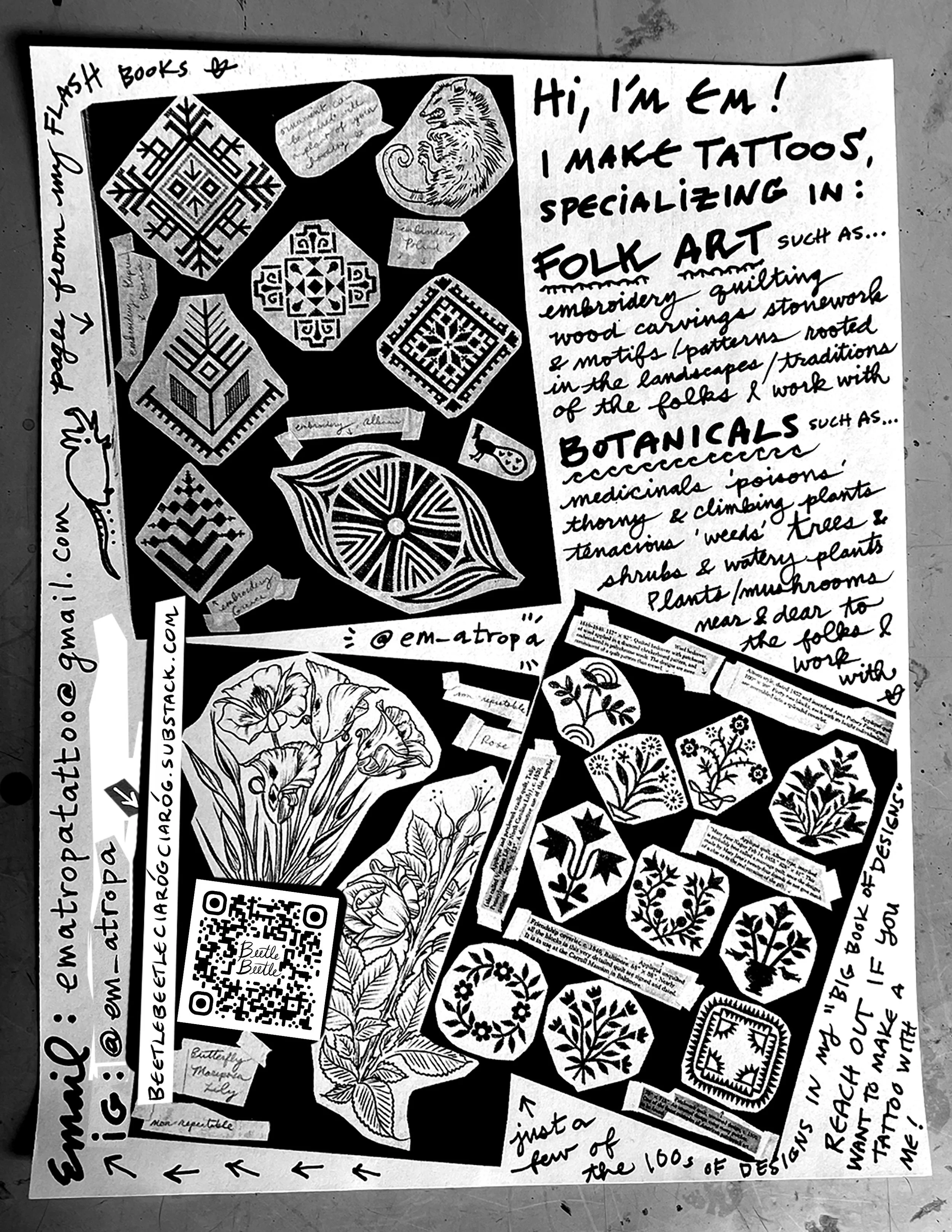
Custom tattoos with plants/mushrooms/algae: Four prompts*
*September 2026 note: You can apply these prompts to regionally-specific folk art as well, which I often pair alongside plants; I will write more about this topic at a later date.
Interested in getting a custom tattoo from me? These days, I've been encouraging people to think about plants/mushrooms/algae they feel especially aligned with, have an ancestral connection to, or an unexplainable connection towards. Here are four ways to consider connecting with plants/mushrooms/algae:
Prompt #1
Get to know the regions in the world your ancestors are from, and do some research about the plants who are native to those places. (PS although the internet *can* be a fine place to do research, I really encourage a visit to your local public library, if possible. Ask a librarian for help if you're not sure how to get started! The collections held at libraries -- books, audio recordings, photographs, etc -- can lead you to wonders you may not have expected to come across!) Some ways plants/mushrooms/algae appear in regional ancestral traditions might include:
* Medicinal/herbal remedies
* Food and drink
* Alcohol/spirits/entheogenic/altered-state preparations
* Folktales, song and games
* Tools and furniture (such as wooden handles made from a tree)
* Visual representations in folk art and crafts (stonework, weavings, metalwork, lace, ceramics, embroidery, etc.)
* Folk magic, dreamwork or astrological associations (like a plant-based amulet worn for protection or placed over a doorway)
* Be curious! Learn their vernacular names prior to colonization, scientific so-called 'discovery' and taxonomization. Names in the 'vernacular' (or the common language used by a group or community) can offer insights about the ways in which people interacted with these plants/mushrooms/algae. Vernacular names can be a gentle way to re-introduce ourselves to languages that our families spoke/sang/whispered/yelled/dreamed/wrote but have been lost, forgotten or erased by internal and/or external systems of oppression. Even learning just a few words or phrases can be moving, regardless if their sounds and cadences are unfamiliar to our ears and mouths. I deeply believe that speaking, hearing, and learning about our ancestral languages can stir something deep in our bellies, blood and bones. And plants/mushrooms/algae can be excellent companions on that path.
Prompt #2
Another way to begin connecting with a plant/mushroom is to share some time and space among them. Remember, there are living beings everywhere, regardless of whether you live in a rural or urban space! Be open-minded about who you feel pulled towards, even if you're not sure why. Take notes, perhaps make a little sketch of the living beings you encounter. This can be a great way to deepen your connection with place. Learning about the plants/mushrooms/algae whom you share regionality with can be a way to unravel both the colonized and the colonizer's mindset. Be curious! Make observations using your senses about the plants/mushrooms/algae you meet. (But certainly take caution before touching a plant without consent, and respect that some of them can poison, sting, puncture, lacerate or burn!) Some questions to consider might include:
* What season is it, and what do they look like at different times of the year? (Shape, size, color, seed pod, etc)
* What do their forms or shapes remind you of?
* Do they have a fragrance?
* Make observations about how and where they like to grow. (Up from the cracks in the sidewalk? At the ocean's edge? What variety of tree stump/log are they growing from? In community with others?)
* What kinds of ways do they change during the morning? Evening?
* What can you learn about their native ranges? Are there varieties of this plant in other places in the world? Observe nuances among the different varieties, shape, habitats, etc. (Regionally specific oaks and their acorns will never cease to amaze me!)
* What are traditional ways in which people interacted with these plants/mushrooms/algae? (See prompt #1)
* Are they a threatened over-harvested species?
* Are they associated with a specific industry or manufacturing?
* What can they teach us about systemic forms of inequities and oppression? Are they connected with historic/contemporary forms of industry, extraction or exploitation?
* What observations can you make about how people interact with them in a contemporary context? (Such as pouring so-called 'weed'-killing poisons on them.)
Prompt #3
A third way is to 'meet with' the spirit of a plant spirit/mushroom. I'll often tell folks that communicating with a plant/mushroom spirit is a skill anyone can develop with practice! And plant communication can look like lots of things. For some, it can look like a meditation, floating in the sea, rambling through the woods, cooking in the kitchen, singing, praying, humming, dancing, drawing, and so on. Keep in mind you don't have to be physically present with a plant/mushroom to connect with them! You can learn how to communicate with plants/mushrooms/algae simply by welcoming their energy/spirit, and seeing/hearing/feeling/etc what comes up. Just be open to what comes up in the process. It might be images, words, sounds, feelings, song, math, and so on. It's important to acknowledge that there are varied forms of cultural practices and traditions of working with plants/mushrooms. Perhaps these practices are part of your own ancestral lineages. Please take care that you respect what your own traditions might be, and avoid embodying the colonizer's mindset in the process of learning/remembering the languages of plants, mushrooms and other nonhumans we share this world with. For this prompt, you may want to consider:
* Give yourself a quiet, uninterupted place/time to do this. Our lives can be busy, but even 10 minutes can be plenty of time to try this out. You may want to ask the folks you live with to respect this time alone.
* Alternatively, you might find it just as effective to be out and about in the world — no need to force yourself to connect with plants/mushrooms/algae in a ‘meditative’ state :)
* Have a notebook or scrap paper ready to take note of what you encountered. Try to make these notes without judgement, ‘correct’ grammar or self-editing.
* You may want to introduce yourself and ask how the plant/mushroom/algae spirit would like to be called. Our names are like special amulets we get to carry around, and they should be honored :)
* With practice, you can learn when your mind has rambled off into imagination world, and when you are connected to the spirit of a plant/mushroom/algae. This might be a difficult distinction to make at first, but it will come with the more work at learning what modes of (receiving) communication suit you best. Trust the process!
* Try not to feel silly or ashamed when trying this out (if it’s new to you). The idea of meeting with a plant/mushroom/algae spirit can easily be put in the category of ‘magical’ thinking. But communication with the other living beings we share this world with can also be considered to be a practice as old as time immemorial. Re-remembering, re-learning or starting a new practice can be challenging. Tús maith leath na hoibre! A good start is half the work!
Prompt #4
And finally, you can ask yourself simple questions about broad categories that you have a curiosity or aversion towards. Ask without judgement! Listen to your gut! Of course, there are some crossovers between these categories. Overall, pay attention to how you feel when you think about each group of plants/mushrooms/alge. Make note of your thoughts when asking yourself how you feel, then perhaps use these thoughts as an entryway into further investigation of specific plants/mushrooms/algae in these groups.
How do you feel about:
* Poisons?
* Medicinal?
* Thorny?
* Things with burs? (like, plants that can get stuck in fur, like burdock!)
* Climbing? (that bend and twist and bind, like vines)
* Voluptuous blossoms? (like irises, roses or lilies)
* Tenacious so-called weeds (like the ones growing up between the cracks of pavement)
* Watery friends? Salt water? Fresh water?)
* Shrubs?
* Trees?
* Fungi?
__
That's that! Let me know if you have any questions, and I'm looking forward to chatting with you more about what plants you have in mind for your design.
Le meas, with respect, em